Watch. Practice. Prove it.
No textbook, no pressure. Learn one clear idea at a time and test yourself when you're ready.
Watch
Short whiteboard videos, one concept at a time. Learn entirely by watching — there's nothing to read.
Practice
Interactive problems after every module let you work the physics yourself, not just watch it.
Prove it
End-of-module exams need 70% to pass — and you can retake them as many times as you like.
Content
20 years teaching this exact course.
Physics that finally clicks.
Frequently asked questions
Does University Physics 2 cover calculus derivations for Gauss's Law and induction?
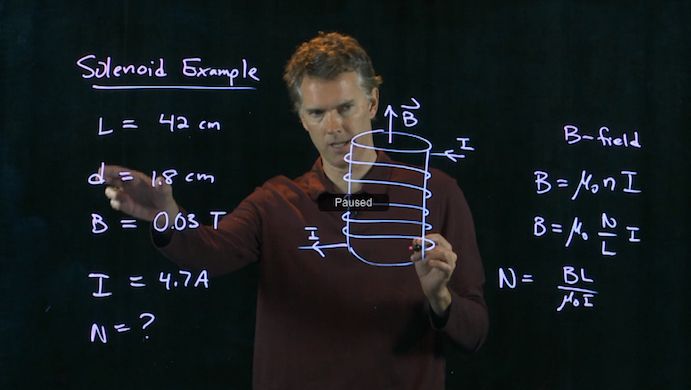
Yes. Rather than relying on simplified algebra shortcuts, Dr. Anderson works through calculus derivations on the lightboard. Students learn how to set up Gaussian surface integrals, calculate line integrals for electric potential and Ampère’s law, apply Faraday's flux derivatives, and understand Maxwell’s equations in integral form.
Is this course suitable for passing AP Physics C: Electricity & Magnetism?
Yes. AP Physics C: E&M is widely considered one of the toughest AP courses due to its heavy reliance on vector calculus and electrodynamics. This course covers the entire AP Physics C: E&M syllabus in depth, giving students the conceptual grounding and mathematical practice needed to score a 5.
Do I need to take University Physics 1 before enrolling in University Physics 2?
While taking mechanics first is standard in university sequences, there is no technical lock on the platform. If you already have credit for Physics 1 or are currently enrolled in a college E&M class, you can jump directly into Semester 2. However, a working foundation in single-variable calculus (derivatives and integrals) and basic vector algebra is strongly recommended.
Which textbooks align with University Physics 2?
The course maps to OpenStax University Physics (Volumes 2 & 3), Halliday & Resnick, Giancoli’s Physics for Scientists and Engineers, and Purcell's Electricity and Magnetism. It serves as an active-learning companion to any standard second-semester engineering physics sequence.
What topics are covered in University Physics 2?
- Semester 2 covers the complete second half of introductory university physics across 14 modules:
- Electric Charge & Coulomb’s Law
- Electric Fields, Dipoles & Continuous Charge Distributions
- Gauss’s Law & Electric Flux
- Electric Potential & Potential Energy
- Relationships Between Field and Potential
- Electric Current, Drift Velocity & Resistance (Ohm’s Law)
- DC Circuits, Kirchhoff’s Rules & RC Circuits
- Magnetic Fields, Lorentz Force & Ampère’s Law
- Electromagnetic Induction, Faraday’s Law & Lenz’s Law
- Electromagnetic Waves & the EM Spectrum
- AC Circuits, Reactance & RLC Resonance
- Geometric Optics, Reflection, Refraction & Thin Lenses
- Optical Instruments, Interference & Diffraction
- Special Relativity (Time Dilation, Length Contraction & Mass-Energy Equivalence)